> For the complete documentation index, see [llms.txt](https://docs.consentik.com/llms.txt). Markdown versions of documentation pages are available by appending `.md` to page URLs; this page is available as [Markdown](https://docs.consentik.com/settings/translations.md).
# Translations
### Introduction
This feature enhances the **Omega Cookie Banner** functionality by allowing merchants to manually translate the text within their cookie banner, categories, and individual cookie descriptions. It provides a comprehensive approach to customizing the user experience for a global audience.
### Translation Detection Methods
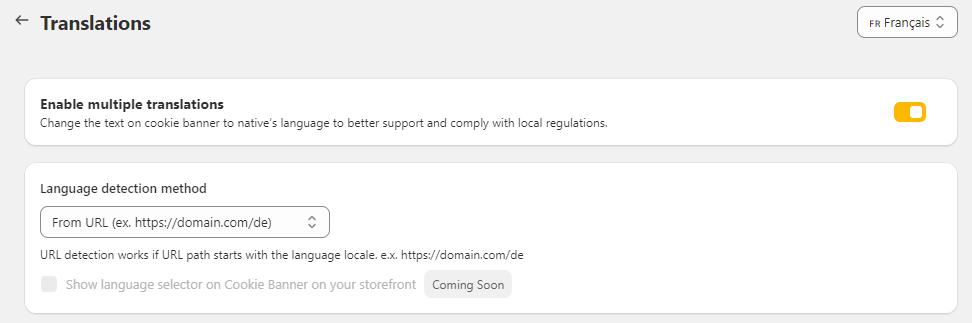
The system offers four methods to determine the appropriate language for displaying the cookie banner, categories, and descriptions:
1. **Store URL Suffix**: Detects language based on the URL structure, e.g., `domain.com/es` for Spanish.
2. **Store Language**: Utilizes the default language set for the store (locale).
3. **User Language**: Detects the user's browser language settings.
4. **User IP Address**: Determines the user's region via IP address and suggests the relevant language.
### Translation Feature Setup
#### Enabling the Translation Feature
Merchants can activate or deactivate the manual translation feature as needed.
#### Selecting Detection Method
Choose the preferred method for detecting which language to present to the user.
#### Language Scopes Selection
Define the languages into which the merchant wishes to translate the cookie banner, categories, and cookie descriptions.
#### Translation Process
The translation process involves a few steps:
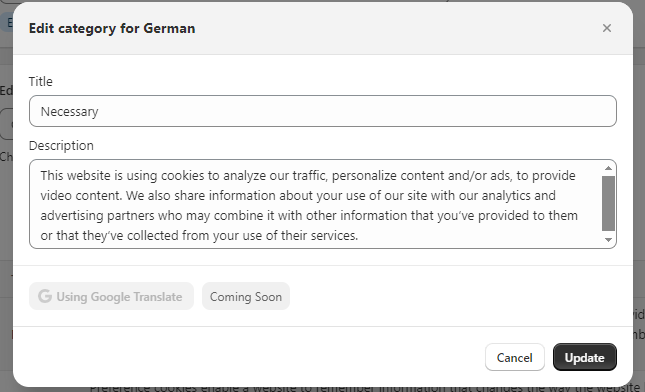
1. **Choose Language**: Select from the list of languages the merchant wishes to provide translations for.
2. **Translate Texts**: Manually input translations for the text of the cookie banner, each category, and individual cookies.
3. **Save Translations**: After translating the texts, save the changes to apply them to the cookie banner.
#### Additional Translation Settings
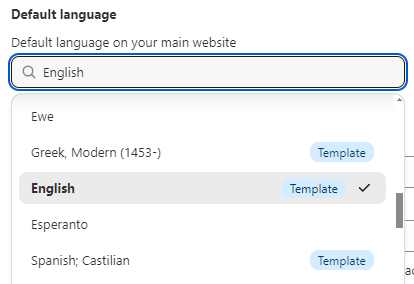
* **Default Language**: In the text customization settings, merchants can choose a default language that will be displayed if no language match is found.
* **Pre-translated Templates**: For some common languages, the app provides pre-translated texts, which are indicated with a "Template" badge.
### Best Practices for Translation
* **Consistency**: Ensure that the tone and terminology are consistent across all translations.
* **Cultural Sensitivity**: Be mindful of cultural nuances and expressions when translating texts.
* **Professional Translation**: For accuracy, consider using professional translation services, especially for legal texts.
By offering manual translation capabilities, this feature empowers merchants to engage with a diverse customer base in a localized and user-friendly manner. It not only improves the user experience but also demonstrates a commitment to accessibility and compliance with international privacy laws.
***Note**: Regularly review translations for accuracy and updates, especially in response to changes in privacy regulations or cookie policies. The translation feature is an enhancement to the cookie banner and should be used in conjunction with comprehensive legal compliance strategies.*