> For the complete documentation index, see [llms.txt](https://docs.consentik.com/llms.txt). Markdown versions of documentation pages are available by appending `.md` to page URLs; this page is available as [Markdown](https://docs.consentik.com/manage-cookies-and-categories/managing-cookies.md).
# Managing cookies
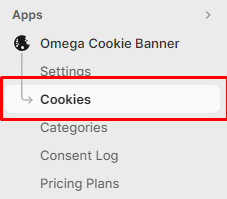
To categorize, publish and unpublish, change name and/or description of the cookies, go to Cookie section on the navigation.
Click on the image to expand
Upon opening, you should see a table with the following columns:
* **No**: The row number.
* **Title**: The name of the cookie, usually the id of that cookie.
* **Description**: The detail of that cookie. This information is usually blank. The description of that cookie will also be visible on the cookie banner.
* **Category**: The category of that banner. By default, there will be 4 categories: Necessary, Preferences, Marketing, Analytics. If you have published the cookie but haven't put it in any category, it will still not be displayed on your cookie banner.
* **Status**: If the cookie has been published or not. Once published, it will be visible for people to see it on your cookie banner so that they are aware of its existence and usage.
* **Scanned**: If the cookie was created by you or scanned from your customers' browsers.
* **Action**: Once hover over the row (cookie), you can opt to edit the cookie's information or delete it.
You can quickly filter out the cookies using the conditions on top of the table:
Alternatively, you can filter out cookies base on their categories. Use this filter:
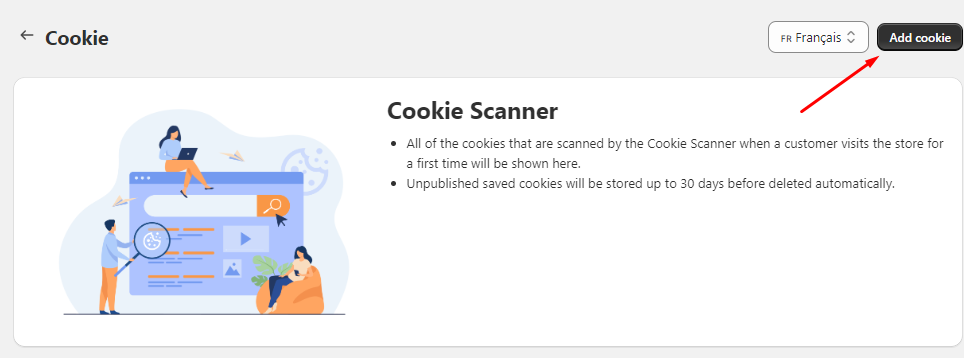
To manually add a new cookie, click on Add cookie button on the top right corner:
A new pop-up will appear. Fill in the information necessary and click Submit to save: